



Import product labeling and relabeling is an important post-import process for many businesses before imported goods enter retail stores, e-commerce channels, distributors or customer locations.
In addition to applying product labels, importers may also require product sorting, SKU verification, quantity checking, repacking, carton labeling and final distribution.
When customs clearance, warehousing, labeling and delivery are handled by separate providers, businesses may need to coordinate multiple logistics contacts and move the same cargo between different facilities. APG SCM can integrate import customs clearance, warehousing, product labeling and inland transportation into one coordinated post-import logistics workflow.
What Is Import Product Labeling and Relabeling?
Import product labeling refers to applying or updating information on imported goods after or as part of the import process, depending on the product category and applicable requirements.
Typical operations may include local-language labels, product information labels, importer information, carton labels, barcodes, SKU labels, batch identification or other customer-specified information.
The actual information required on a product depends on its category, intended use and applicable market requirements. The logistics operation should therefore follow the confirmed labeling specifications provided for each product.
Why Do Imported Products Need Relabeling?
Products manufactured for overseas markets are usually packaged according to the requirements and commercial practices of their original market.
When those products are imported into Taiwan or another destination market, additional product information may be required before the goods enter local distribution channels.
Businesses may also require relabeling for branding, product identification, SKU management or different retail channels.
What Types of Businesses Need Import Labeling Services?
Import product labeling and relabeling may be useful for:
- Importers and trading companies
- Brand distributors
- Food and beverage importers
- Health and nutrition product companies
- Consumer goods importers
- E-commerce and cross-border sellers
- Businesses distributing products through multiple retail channels
Requirements vary by product category, so labeling specifications should be confirmed before large-scale processing begins.
What Is the Typical Import Labeling Workflow?
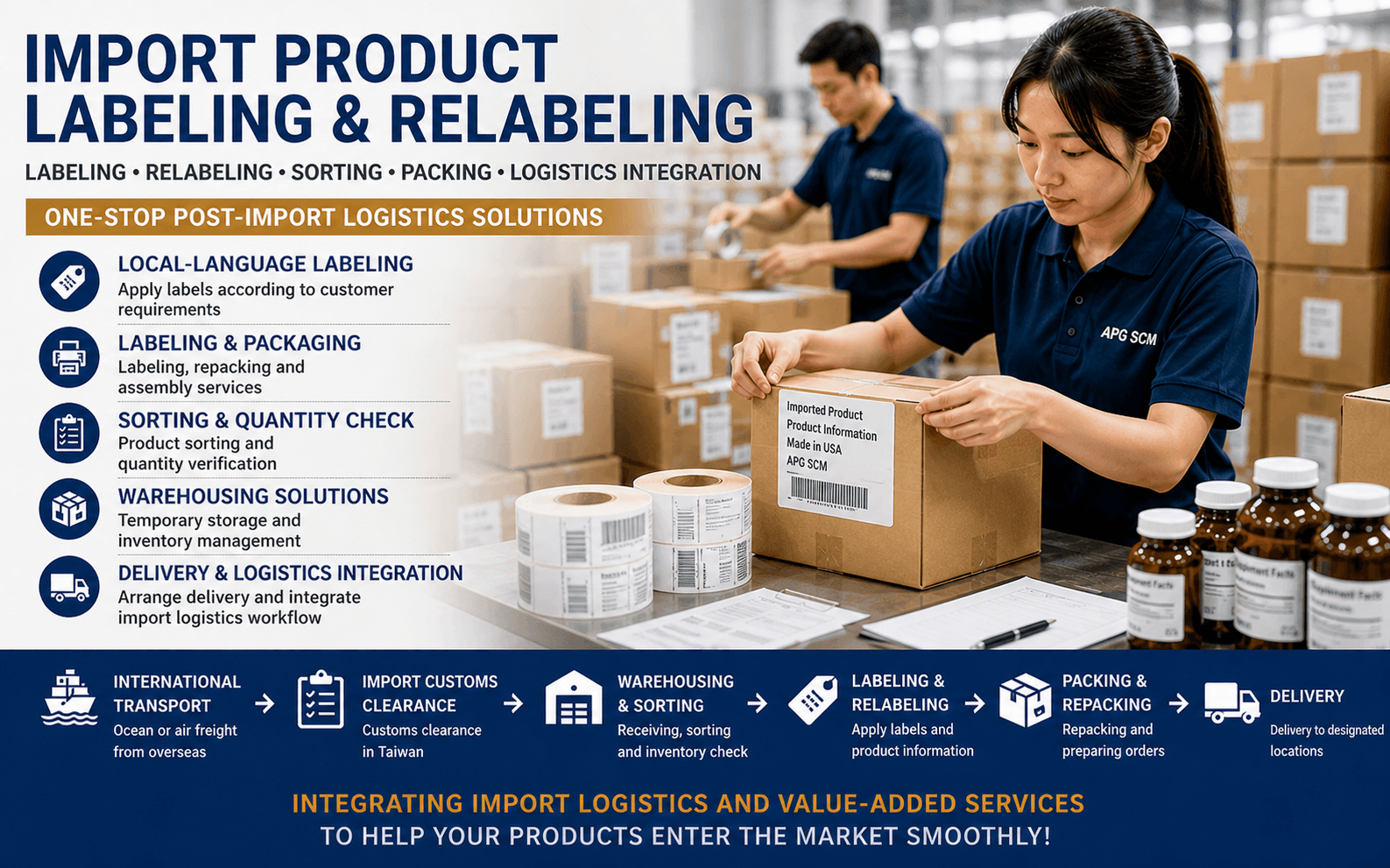
Depending on the project, a post-import logistics workflow may include:
Overseas Shipment → International Transportation → Import Customs Clearance → Warehouse Receiving → Quantity Check → SKU Sorting → Labeling / Relabeling → Repacking → Warehousing → Final Distribution
Managing these operations within one coordinated workflow can reduce unnecessary cargo transfers and make inventory and processing progress easier to monitor.
Why Is SKU Sorting Important Before Labeling?
Large import shipments may contain multiple SKUs, package sizes, product variations or label versions.
Applying labels before products are properly sorted may increase the risk of using the wrong label on the wrong item.
Before labeling begins, the warehouse operation may therefore include:
- Product identification
- Quantity verification
- SKU sorting
- Label version confirmation
- Label placement confirmation
- Processing quantity verification
This preparation helps create a more controlled labeling and repacking process.
Can Labeling, Sorting and Repacking Be Combined?
Yes, depending on the operational requirements. Imported products may require more than labeling alone.
After labels are applied, products can also be counted, sorted, repacked, placed into new cartons or prepared for specific customers or sales channels.
Combining these tasks within one warehouse operation can reduce repeated cargo handling and simplify downstream logistics.
Can Imported Goods Be Labeled After Customs Clearance?
Depending on the product category and applicable requirements, some imported goods may be transferred to a warehouse after customs clearance for downstream operations such as labeling, sorting and repacking.
However, importers should confirm the relevant product and labeling requirements before arranging the shipment to avoid discovering documentation or labeling issues after arrival.
APG SCM can coordinate international shipping, customs clearance and downstream warehouse operations according to the project requirements.
How Can Integrated Warehouse Labeling Reduce Logistics Costs?
If imported cargo must be transported from the customs clearance location to a separate labeling facility, then to another repacking provider and finally to a warehouse, the shipment may require multiple additional movements.
Integrating warehousing, sorting, labeling and repacking can reduce unnecessary cargo transfers and simplify inventory management.
This approach can be particularly useful for businesses importing goods regularly or managing larger shipment volumes.
Can Products Be Delivered Directly After Labeling?
After labeling, sorting and repacking are completed, products can be prepared for delivery to warehouses, retailers, business customers or other designated locations.
When products do not need to be shipped immediately, they can remain in warehouse storage until orders or delivery schedules are confirmed.
How Does APG SCM Integrate Import Product Labeling?
APG SCM provides international transportation, import and export customs clearance, warehousing, cargo sorting, product labeling, repacking and inland delivery services.
The objective is not only to apply a label to a product, but to coordinate the wider process from overseas shipment and import customs clearance through warehouse processing and final distribution.
If your company requires import product labeling, product relabeling, warehouse sorting, repacking or post-import logistics services, please contact APG SCM to discuss your requirements.
Import Product Labeling FAQ
Do all imported products require local-language labels?
Labeling requirements vary depending on the product category, intended use and applicable requirements. Businesses should confirm the relevant requirements before importing and distributing the product.
Should imported products be labeled before or after customs clearance?
The appropriate timing depends on the product category and applicable requirements. Some products may be processed in a warehouse after customs clearance, while others may require specific preparation earlier.
Can different SKUs use different labels?
Yes. Products can first be sorted by SKU, product type or label version, with quantities and label specifications confirmed before processing begins.
Can products be repacked after labeling?
Depending on the project requirements, labeling can be combined with sorting, carton handling, repacking and order preparation before warehousing or final delivery.
What post-import services can APG SCM coordinate?
Depending on the project, APG SCM can coordinate international transportation, customs clearance, warehousing, sorting, product labeling, repacking and inland delivery as part of an integrated logistics workflow.
Have a similar import, export or logistics requirement?
Contact APG SCM to discuss your cargo, origin, timeline and the most suitable logistics approach.
Contact us→