



Import and export permit assistance is an important part of international trade when products are subject to additional documentation, certification or approval requirements before customs clearance can be completed.
Depending on the product category, intended use, country of origin and destination market, businesses may need to prepare specific permits, certificates or supporting documents before arranging international transportation.
If missing documentation is discovered after the cargo has already departed, it may affect customs clearance, cargo release, warehousing and delivery schedules.
What Is an Import or Export Permit?
An import or export permit is a document, approval, registration or supporting requirement that may apply to certain products before they can be imported or exported.
Not every product requires a special permit. The actual requirements depend on the product classification, intended use, origin, destination and applicable regulations.
What Types of Products May Require Additional Import or Export Documentation?
Depending on the product and applicable requirements, additional documentation may be relevant for categories such as:
- Food and beverage products
- Wine and alcoholic beverages
- Health and nutrition products
- Cosmetics and related products
- Special-purpose machinery or equipment
- Controlled materials or commercial goods
- Other products subject to specific import or export requirements
Whether a permit is required should be determined according to the actual product conditions, rather than the product name alone.
Why Should Permit Requirements Be Confirmed Before Shipment?
One of the most common causes of international logistics delays is discovering missing documentation after international transportation has already been arranged.
If additional documents must be prepared after the cargo has departed, businesses may face delays, storage charges, port-related costs or missed delivery schedules.
Confirming import and export requirements before booking a vessel or flight helps customs and logistics operations move more smoothly.
What Information Is Commonly Needed for Import or Export Permit Preparation?
The required information varies by product and procedure, but businesses may need to prepare:
- Product name and intended use
- Product specifications or model numbers
- Ingredients or material information
- Country of origin
- Manufacturer or supplier details
- Commercial invoice
- Packing List
- Product catalogues or supporting documents
- Destination or import country information
Providing complete product information at an early stage can make it easier to determine the next documentation, customs and transportation steps.
How Are Import Permits Related to Customs Clearance?
Import permits and customs clearance are related processes, but they are not necessarily the same procedure.
Some products may require specific documentation or approvals before the documents can be used during import customs clearance.
For this reason, customs documentation should be reviewed before cargo arrival whenever possible.
How Do Export Permits Work with Export Customs Clearance?
Export shipments may also involve specific product information, destination requirements or supporting certificates.
When additional documentation is required, the processing time should be included in the overall shipment schedule along with vessel bookings, flight schedules and export customs clearance.
Coordinating documentation and logistics planning together helps reduce last-minute changes.
Can Permits, Customs Clearance and Logistics Be Integrated?
Depending on the project, the overall workflow may include:
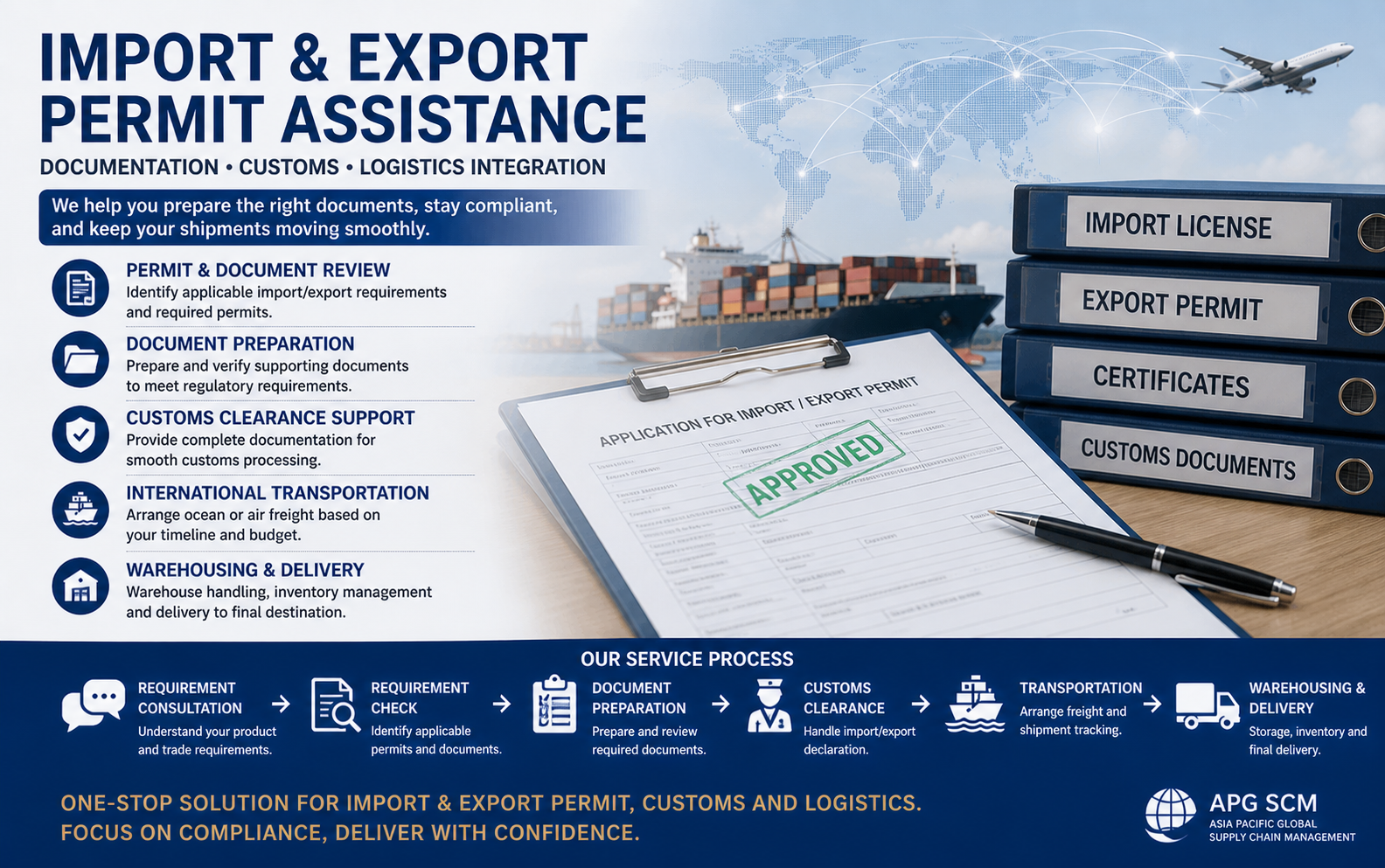
Product Information Review → Import / Export Requirement Check → Permit or Document Preparation → International Transportation → Customs Clearance → Cargo Release → Warehousing → Final Delivery
APG SCM can coordinate documentation, customs clearance, international transportation, warehousing and inland delivery as part of one supply chain workflow.
Why Do Businesses Encounter Import and Export Documentation Problems?
Common causes include incomplete product information, unclear descriptions, inconsistent documentation between suppliers and importers, or failing to confirm requirements before shipment.
If the supplier, importer, customs broker and logistics provider are working with different information, additional confirmation or document revisions may be required.
Maintaining one accurate set of product information helps improve the efficiency of international trade operations.
What Can APG SCM Coordinate for Import and Export Permit Projects?
Depending on the product and project requirements, APG SCM can assist in coordinating the information and documentation required for customs and logistics operations, together with international transportation, customs clearance, warehousing and delivery.
Actual permit, certificate or regulatory approval requirements depend on the product category and applicable procedures.
If your business requires import or export permit assistance, import-export documentation, customs clearance or international logistics support, please contact APG SCM to discuss your requirements.
Import & Export Permit FAQ
Do all imported or exported products require a permit?
No. Permit and documentation requirements depend on the product category, intended use, origin, destination and applicable requirements.
Can an import permit be handled after the cargo arrives?
Where specific documentation is required, businesses should generally confirm the requirement before shipment rather than waiting until cargo arrival. This helps reduce customs and logistics delays.
How long does import or export permit processing take?
Processing time varies according to the product, procedure, document completeness and applicable authority. There is no single processing period that applies to every product.
Can APG SCM guarantee that an import or export permit will be approved?
Approval depends on the product conditions, submitted documentation and applicable procedures. APG SCM can assist with coordination and documentation-related logistics planning, but regulatory approval cannot be treated as an unconditional guarantee.
Is customs clearance still required after a permit is obtained?
Yes. A permit or supporting certificate does not normally replace the customs declaration process. The cargo must still complete the applicable import or export customs procedures.
Have a similar import, export or logistics requirement?
Contact APG SCM to discuss your cargo, origin, timeline and the most suitable logistics approach.
Contact us→