



Food Import to Taiwan Case Study | Customs Clearance, Food Inspection and International Logistics
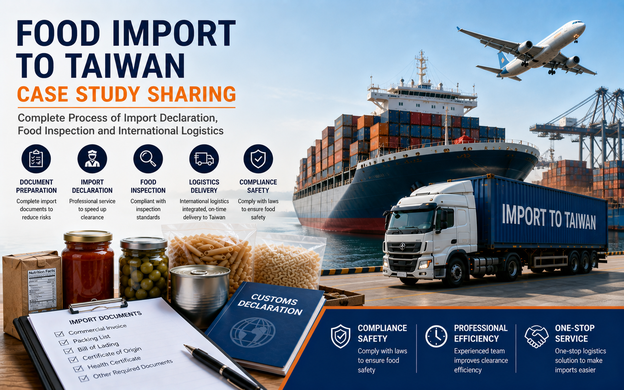
Importing food products into Taiwan involves more than arranging international transportation. Businesses must also consider product documentation, customs clearance, food inspection procedures, import compliance and local delivery.
In this case study, APG SCM explains how a food import project was planned from pre-shipment document review through international transportation, customs declaration, inspection procedures and final delivery in Taiwan.
The objective was to reduce the risk of documentation issues, customs delays and unnecessary storage costs after the cargo arrived in Taiwan.
Case Background: Importing Food Products into Taiwan
The client planned to import a shipment of food products from overseas into Taiwan. The project required coordination across several stages, including international transportation, import documentation, customs clearance, food-related inspection procedures and local delivery.
One of the most common challenges in food imports is not transportation itself, but inconsistencies between product information, shipping documents and the actual cargo.
If missing or inconsistent information is discovered only after the shipment arrives in Taiwan, the importer may face additional document requests, storage charges and longer clearance times.
What Information Should Be Prepared Before Importing Food into Taiwan?
Before shipment, businesses should prepare basic product information and import documents so that logistics and customs procedures can be reviewed in advance.
1. Product Name and Product Information
The first step is to confirm the exact product name, product category, intended use, packaging format and basic product characteristics.
Different food products may be subject to different import requirements depending on their ingredients, processing methods, origin and intended use.
2. Commercial and Shipping Documents
Common documents used in food import shipments may include:
- Commercial Invoice
- Packing List
- Bill of Lading or Air Waybill
- Product information
- Country of origin information
- Additional documents required for the specific product
Product names, quantities, weights and other information shown on the commercial documents should be consistent with the actual shipment whenever possible.
Accurate documentation can reduce the need for additional clarification during customs clearance.
3. Food Product Information
Food imports may also require more detailed product information, such as:
- Ingredients
- Manufacturing or processing method
- Country of origin
- Packaging specifications
- Manufacturer information
- Information related to Chinese labeling
For this reason, APG SCM recommends reviewing key product information before the shipment leaves the country of origin, rather than waiting until the cargo arrives in Taiwan.
International Logistics Planning for Food Imports
Once the documentation has been reviewed, the next step is to evaluate the most appropriate transportation method based on shipment volume, delivery schedule and product requirements.
Typical considerations include:
- Cargo weight and volume
- Product storage requirements
- Required arrival date
- Country and city of origin
- Air freight versus sea freight cost
- Customs clearance lead time
- Inspection and local delivery requirements
Air freight may be suitable for smaller or time-sensitive shipments, while sea freight may be considered for larger shipments with more flexible lead times.
Businesses should not evaluate logistics costs based only on the international freight rate. The total import cost may also include customs clearance, inspection, storage and local transportation in Taiwan.
Customs Clearance After the Cargo Arrives in Taiwan
After the shipment arrives in Taiwan, the cargo enters the import customs clearance process. Customs declarations are prepared according to the shipment documents, product information and actual cargo conditions.
This is where accurate pre-shipment preparation becomes especially important. When the Commercial Invoice, Packing List and product information are consistent, the customs process is generally easier to manage.
If discrepancies are identified after arrival, additional explanations or supporting documents may be required, which can extend the overall clearance timeline.
Food Inspection and Import Procedures in Taiwan
Food products are different from many general industrial goods because the import process may involve food-related inspection or document review, depending on the product category and actual import conditions.
Therefore, businesses should not estimate the delivery schedule based only on standard customs clearance time.
If the imported products are connected to a retail launch, promotional campaign or inventory schedule, possible inspection and processing time should also be included in the supply chain plan.
Key Steps in This Food Import Case
The key objective of this project was not simply to complete customs clearance, but to identify potential issues before the shipment arrived in Taiwan.
Before Shipment
Product information and import documents were reviewed in advance to reduce the risk of missing information after arrival.
During International Transportation
The transportation method and expected arrival schedule were coordinated according to the shipment requirements.
After Arrival in Taiwan
Customs clearance and relevant food import procedures were coordinated, while shipment status was monitored throughout the process.
After Customs Clearance
Local transportation was arranged so the cargo could be delivered according to the client's warehouse and operational schedule.
Why Should Food Imports Be Planned Before Shipment?
Many first-time importers focus primarily on international freight costs. However, transportation is only one part of the total import process.
Other potential costs and risks may include:
- Delays caused by incomplete documentation
- Storage charges
- Additional document preparation
- Inspection waiting time
- Additional local logistics arrangements
- Business impact caused by delayed delivery
Reviewing the import requirements before shipment can help businesses identify potential issues earlier and improve the predictability of the logistics process.
How Can APG SCM Support Food Imports into Taiwan?
APG SCM provides international logistics and import-export coordination services for businesses moving goods between Taiwan and overseas markets.
Depending on the cargo conditions and shipment requirements, APG SCM can assist with the coordination of:
- Food imports into Taiwan
- International air freight
- International sea freight
- Import customs clearance
- Export customs procedures
- Cross-border logistics
- China-to-Taiwan shipments
- Hong Kong-to-Taiwan shipments
- Japan-to-Taiwan shipments
- Local transportation in Taiwan
Businesses planning to import food products into Taiwan should prepare the product name, origin, ingredients, shipment volume and expected delivery schedule before arranging transportation.
This information allows the logistics and import process to be evaluated earlier and helps reduce the risk of unexpected delays after arrival.
Frequently Asked Questions About Food Imports into Taiwan
What documents are commonly needed to import food into Taiwan?
Common documents may include a Commercial Invoice, Packing List, transportation documents, product information, country of origin information and other documents required according to the specific product.
Does food imported into Taiwan require customs clearance?
Imported food products generally need to go through import declaration and customs clearance procedures. The exact process depends on the product, origin and import conditions.
Can food products be shipped to Taiwan by air freight?
Yes. Air freight may be suitable for smaller shipments, urgent deliveries or products with stricter delivery schedules. Larger shipments with more flexible lead times may also consider sea freight.
Should import documents be prepared before the cargo arrives in Taiwan?
Yes. Preparing and reviewing the documents before shipment can reduce the risk of additional document requests, storage costs and clearance delays.
Can APG SCM assist with food import logistics and customs clearance?
APG SCM can assist businesses with international transportation, import logistics coordination, customs clearance and local delivery planning based on the actual cargo and shipment requirements.
Have a similar import, export or logistics requirement?
Contact APG SCM to discuss your cargo, origin, timeline and the most suitable logistics approach.
Contact us→