



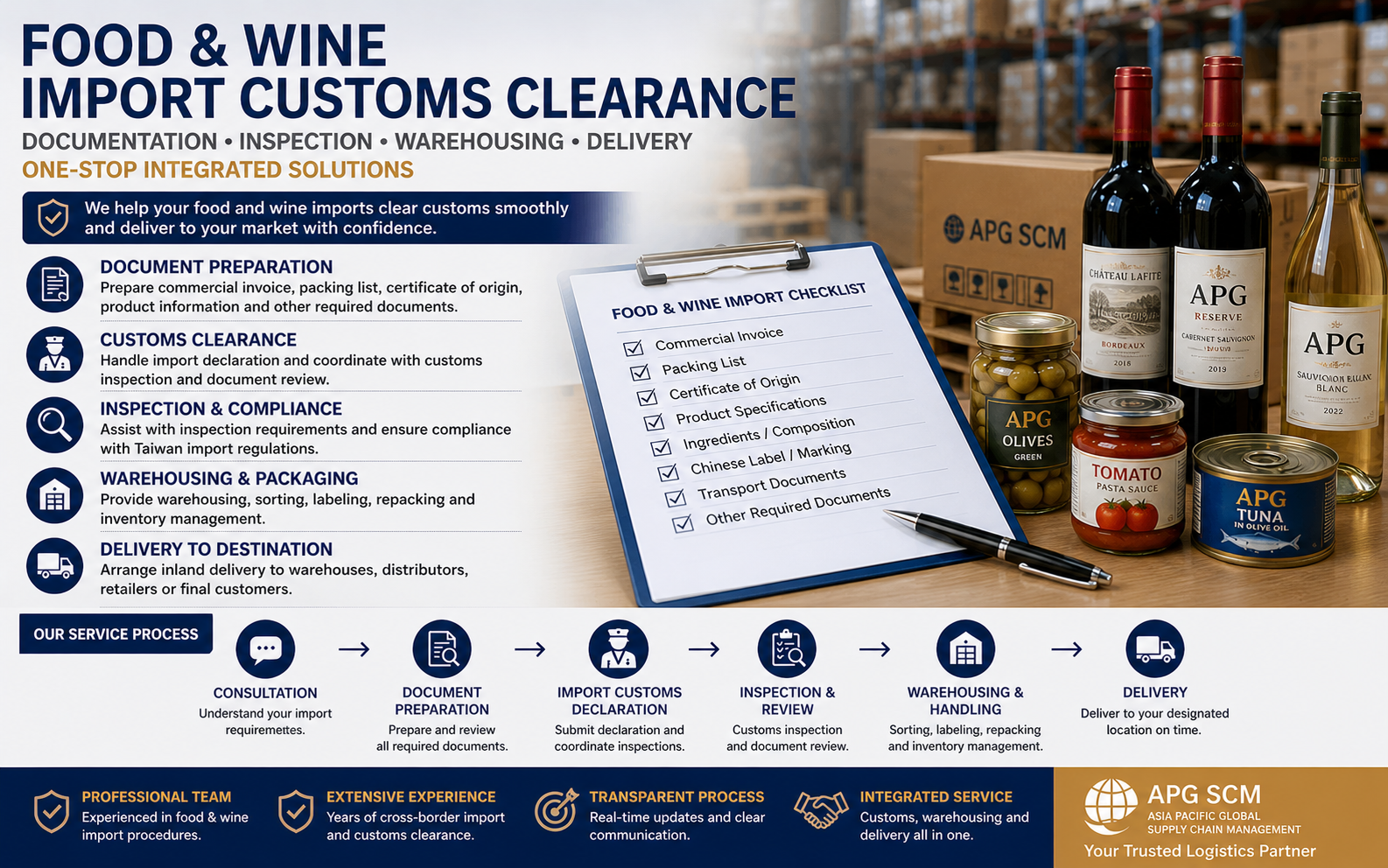
Food and wine import customs clearance requires more than arranging international transportation. Importers may also need to coordinate product documentation, customs declarations, inspection-related preparation, local labeling, warehousing and final distribution.
If product information is reviewed only after cargo arrival, businesses may face additional document requests, delays and storage costs. For this reason, food and wine import projects should be planned before the shipment departs.
What Is Food and Wine Import Customs Clearance?
Food and wine import customs clearance refers to the import declaration and related procedures required before commercial food or alcoholic beverage products can be released into the destination market.
Depending on the product, the workflow may involve:
- Product information review
- Commercial Invoice and Packing List preparation
- Manufacturer and origin information
- Import customs declaration
- Inspection or document review preparation
- Local labeling confirmation
- Warehousing and downstream delivery
What Documents Are Commonly Needed Before Importing Food or Wine?
Requirements vary by product, but businesses should usually prepare:
- Product names and item information
- Ingredients or product specifications
- Manufacturer and supplier information
- Country of origin
- Commercial Invoice
- Packing List
- Transportation documents
- Packaging and labeling information
For wine and alcoholic beverages, additional product details such as alcohol content, bottle volume, brand and origin information should also be confirmed.
Why Do Food Imports Commonly Encounter Documentation Issues?
Food products often require more detailed product information than general commercial cargo.
Common issues may include:
- Inconsistent product descriptions
- Incomplete ingredient information
- Missing manufacturer details
- Unconfirmed labeling information
- Additional documentation discovered after shipment
This is why food import preparation should focus on document accuracy before cargo departure.
What Should Importers Consider When Importing Wine?
Wine imports may require more detailed product information than ordinary commercial cargo.
Importers should confirm the product name, alcohol percentage, bottle volume, brand, country of origin and manufacturer information before arranging import customs clearance.
What Is the Typical Food and Wine Import Workflow?
Depending on the product, a typical workflow may include:
Product Review → Document Preparation → International Transportation → Import Customs Clearance → Inspection or Document Review → Cargo Release → Warehousing → Labeling / Repacking → Final Distribution
Planning customs, documentation and logistics together helps reduce last-minute issues after cargo arrival.
Can Food and Wine Be Warehoused After Customs Clearance?
Yes, depending on the product and project requirements. After customs clearance, cargo may be transferred to warehousing for inventory handling, sorting or scheduled distribution.
This can be useful when goods do not need to be delivered immediately.
Can Imported Food or Wine Be Labeled in the Warehouse?
Depending on the product and applicable requirements, labeling, sorting or repacking may be integrated into the warehouse workflow.
Businesses should confirm the required label content before import whenever possible to avoid unnecessary rework after customs clearance.
Why Is Integrated Logistics Useful for Food and Wine Imports?
Food and wine imports may involve international transportation, customs clearance, documentation, inspection-related preparation, warehousing, labeling and delivery.
When each activity is handled separately, businesses may need to coordinate multiple providers.
Integrating international transportation, customs clearance, warehousing and inland delivery can help reduce communication gaps.
What Types of Businesses Use Food and Wine Import Logistics Services?
- Food importers
- Wine and alcoholic beverage importers
- Brand distributors
- Restaurant and retail groups
- E-commerce businesses
- Importers requiring warehousing and scheduled distribution
How Does APG SCM Support Food and Wine Imports?
Depending on the product and project requirements, APG SCM can coordinate international transportation, food and wine import customs clearance, warehousing, cargo handling, labeling and final delivery.
The objective is not simply to complete a customs declaration, but to coordinate the wider supply chain from overseas shipment through customs release, warehouse handling and downstream distribution.
If your company requires food import customs clearance, wine import customs clearance, warehousing, labeling or import logistics support, please contact APG SCM.
Food & Wine Import Customs FAQ
Are all food imports inspected?
Inspection or document review requirements depend on the product, declaration details and applicable procedures. Not all food products are handled in exactly the same way.
What information is commonly needed for wine imports?
Importers should generally prepare the product name, brand, alcohol content, bottle volume, country of origin, manufacturer details, Commercial Invoice, Packing List and transportation documents.
Can local labels be applied after arrival?
The timing depends on the product and applicable requirements. Businesses should confirm the required label content before shipment whenever possible.
Can food be stored and delivered in multiple batches?
Yes, depending on the project. After customs clearance, cargo may be stored, sorted and distributed according to customer orders or delivery schedules.
Can APG SCM coordinate customs, warehousing and delivery together?
Depending on the shipment conditions, APG SCM can coordinate international transportation, customs clearance, warehousing, cargo handling and final distribution within one integrated workflow.
Have a similar import, export or logistics requirement?
Contact APG SCM to discuss your cargo, origin, timeline and the most suitable logistics approach.
Contact us→